

As the only male teacher in my elementary building, year after year I’ve often been given “those kids who need a male influence.” And if you don’t know, that’s kind of code for kids who come with major behavior challenges.
Particularly post pandemic it felt like the sheer number of students was behavior problems was increasing each year. Each year I would get more and more kids could not regulate their emotions. More kids “eloping” – a brand new term for kids who would just run out of the room or even the building. More of my fourth graders began exhibiting immature behaviors I’d normally expect from much younger students such not being able to tie shoes, tattling, tantrums, crying or shutting down, needing constant reassurance, etc…)
Despite often being assigned the most challenging students each year, I’ve never complained about it. Instead, I’ve accepted these students knowing I might have something to offer that could help steer them in a better direction. I wasn’t always great at it, but through the years I’ve learned strategies, studied the techniques of master teachers, and—maybe most importantly—learned through my own mistakes.
Let’s just say, that classroom management didn’t just come naturally to me. I never had any classes in college which specifically gave me any instruction on this topic – which, looking back is kind of crazy since it is so central to the job. Even as a veteran teacher, it is easy to have a bad day, lose your temper or lose control of your class and really get down on yourself. Important first rule: give yourself grace.
Though I had a slow start, each year I got a little better, and today I’d say classroom management is one of my strengths.
1. Standing on the Shoulders of Experts
Classroom management and student interaction is as much an art as it is a science. Many of my classroom procedures and expectations have been shaped by other great teachers such as master teacher Harry Wong or behavior specialist (The Kid Whisperer) Scott Ervin. I highly encourage any teachers who struggle in this area to read these books below. They are worth their weight in gold.


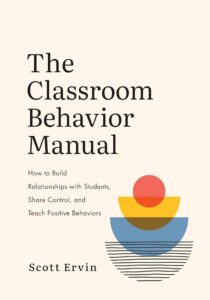
In addition to these experts, I picked up a lot from the great teachers who taught (showed) me, especially the ones who mentored me as a young teacher. Today, I continue to pay this forward by working with student teachers each year. In the end, there isn’t a one-size-fits-all solution, but there are principles and strategies that consistently help. I want to share a few ideas that work for me.
When I started teaching, a common axiom was, “Don’t smile until Christmas.” While I don’t subscribe to this belief, one of the underlying ideas inherent in this statement is true: it’s easier to start off with firm expectations and then gradually relax as you get to know your students than it is to begin too easy, soft, or lenient and then have to pull things back later. Students respond better when boundaries are clear from the start, and once that structure is established, you can let your warmth and humor shine without losing control of the classroom.
2. Start with Relationships, Not Rules
This is a principle I learned in college that still holds true today: Kids don’t care what you know until they know you care.
Before students buy into expectations, they need to feel seen, heard, and valued. Simple things—greeting them at the door, learning their interests, celebrating their wins—all these things set the stage for cooperation. See my post on establishing a positive classroom culture at the start of the year for some ideas.

3. Structure Creates Freedom
Borrowing from the legendary Harry Wong, the first days are everything. I spend extra time setting clear, predictable routines. When students know what to expect, they feel safe—and when they feel safe, behavior problems drop dramatically.
I am super specific with routines – from how to enter the classroom, how to hang up things properly in their locker, how to put things in folders, how to organize their desk, how to line up for the computer cart – EVERYTHING has a procedure. Many teachers assume kids know how to do very simple things correctly, things like washing their hands in the bathroom, but many do not. Take the time to teach them the right ways to do things and practice them as much as is necessary.

More than ever, students today crave consistency and predictability. Students need to know their daily schedule and what is expected of them at different times of the day. Students always need to know, “What’s next?” I have a daily agenda posted each day, and then a detailed agenda of what we are doing in each subject.
4. Don’t Just Correct, Coach
Instead of nagging or saying, “Stop that,” I try to frame corrections as guidance:
- “Let’s try that again the right way.”
- “Show me what that should look like.”
- “I know you can do this.”This shifts the interaction from punishment to growth.
If a student is really struggling with a negative behavior, my response is, “We can do some learning on that later.” Then, during their free time (usually recess) we practice the expected behavior together.
The few minutes you spend practicing in the moment may feel like a sacrifice, but it pays off. That small investment early on will save you tenfold in instructional time that isn’t lost to repeated disruptions throughout the year.
5. Choices, Not Power Struggles
From The Classroom Behavior Manual: Whenever possible, give students choices that lead to the same outcome. For example: “You can start your work at your desk or at the back table—your choice.” Giving control in small ways prevents bigger battles.
Sometimes I will say something like: “This is your work time, if you are playing during your work time then your play time (recess) will become your work time.” And importantly, always follow through. If you find that you have a problem overreacting or over punishing, read my next tip.

6. Stay Calm, Even When It’s Hard
This one is easier said than done, but I’ve learned that my energy sets the tone. If I escalate, my students escalate. If I stay steady, I help them regulate too. Sometimes that means pausing, taking a breath, or using a softer voice instead of a louder one. I have a rule that I never provide a consequence when I’m upset. As a parent, I know there were times where my kids made me so mad, that I overreacted with my consequence – “You’re grounded until you’re 16!!” I’m sure many parents out there can relate.
I learned from The Kid Whisperer (Scott Ervin) that it is better to simply say, “We’ll do some learning on that later.” That gives me the opportunity to calm down and think about a fitting way to practice the behavior the student was struggling with that is appropriate.

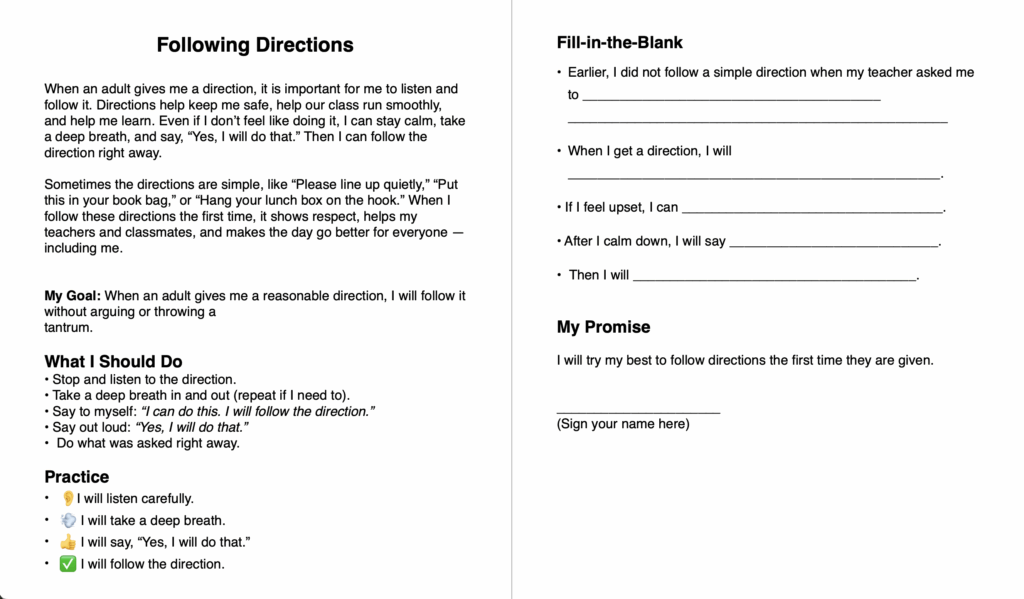
But, be sure to follow up with lesson on the behavior that the student is struggling with. If you’re having trouble coming up with what to do, Chat GPT/Google Gemini are great at creating social stories for kids to read with you and use as a discussion starter. Here’s an example 2-pager I made for a student struggling with following my directions using Chat GPT in about 5 minutes before school. It even added the emojis for formatting in its 2nd attempt.
7. Celebrate the Small Wins
I make it a point to notice when students make progress, even if it’s tiny: “I saw you pause before reacting—that’s growth!” Recognition builds momentum, especially for kids who are used to being told what they’re doing wrong. Strategically notice the kids doing what is expected and you will see big changes.
- I noticed Chloe quietly opened to page 17.
- I noticed that Jaden has his hands still and is looking at me.
- I noticed that Logan is walking quietly on the right side of the hallway.
- I noticed Layla is speaking with her team at a level one volume.
If you make strategic noticing a part of your teacher toolbox you will be amazed at its powerful impact. It will feel weird at first, but stick with it and you will see big changes in your students.


8. High Engagement = Less Behavior Problems
One of the biggest lessons I’ve learned is that most behavior problems disappear when students are truly engaged. If kids are interested, active, and challenged at the right level, there’s simply less space for off-task behavior to creep in.

That doesn’t mean you have to turn every lesson into a Broadway production, but it does mean finding ways to involve students in meaningful ways—whether that’s through movement, discussion, hands-on practice, or even giving them choices in how they learn.
As Wong reminds us in The First Days of School, structure and clarity matter, but so does energy. If you bring enthusiasm and set up activities that pull students in, you’ll notice a big drop in discipline issues.
I’ve seen this play out again and again: the more my students are leaning forward, the less I need to correct them.
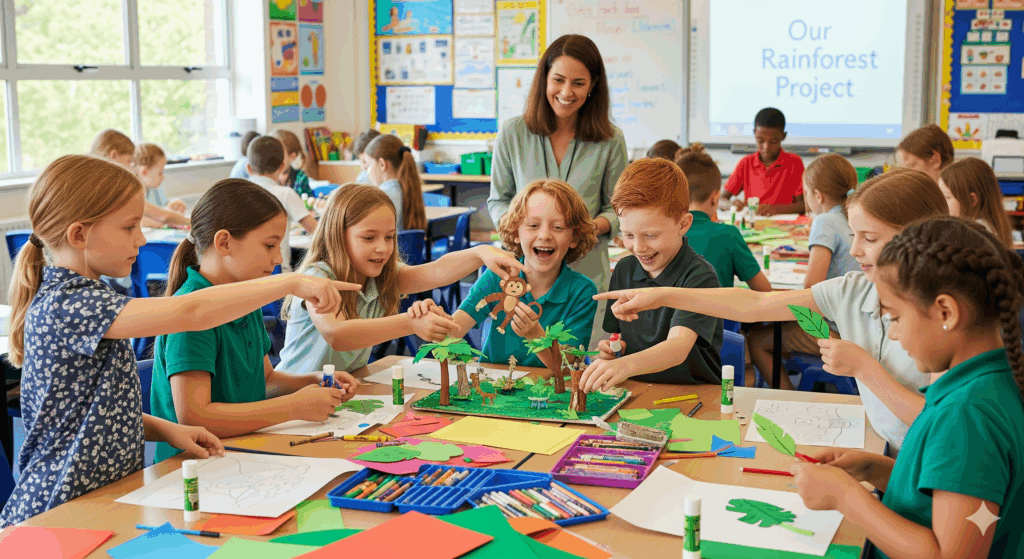
My classroom includes a lot of things that increase engagement: we play a lot of games like Kahoot and Gimlet, we work in teams to complete escape games, we do a lot of parter and group work, and there are many opportunities for students to be challenged. I am always asking myself as a teacher, “What can I do to make this activity more fun?”
9. Adaptability Is Key
I sometimes joke with colleagues that student behavior can feel a little like containing the raptors in Jurassic Park. In the movie, the very smart raptors constantly test the electric fences, looking for weak spots. Kids do the same with boundaries. The moment you address one behavior, a new one may pop up as they “test the fence” in another area. It’s not defiance for the sake of defiance—it’s how kids learn where the limits are. Our job isn’t to build an unbreakable fence, but to stay consistent, patch the weak spots, and show them that the structure is steady enough to hold.

10. Releasing Responsibility to Students
One of the most effective shifts in the past few years I’ve made in classroom management is releasing responsibility to my students. And I’ll be honest, as an “old school” educator, it was hard for me to give up this control. Instead of me being the constant enforcer, I set up systems where students hold each other accountable.
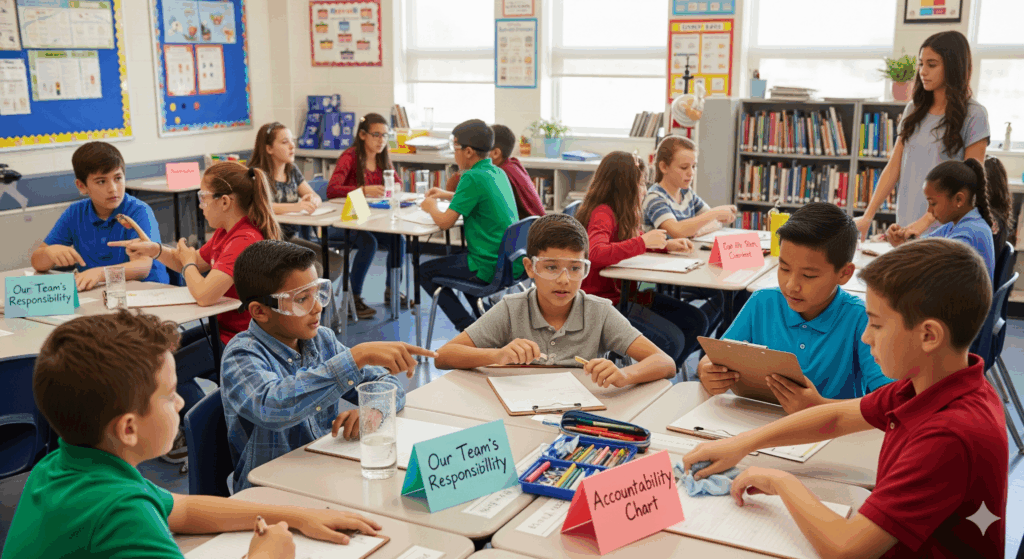
In my room, students sit in table groups, and each group is responsible as a team to be ready before transitions—whether that’s dismissal, heading to lunch, or wrapping up the day. This means they’re checking on each other, encouraging one another, and working together to meet expectations.
I also assign classroom jobs that empower students. For example, I have students who release groups when they are ready—desks organized, floors picked up, and materials in place. This takes the focus off me being the “checker” and shifts it to the class community.
When students are given this responsibility, it not only builds independence but also strengthens teamwork. They begin to understand that the classroom belongs to all of us, and that makes expectations easier to maintain without constant reminders from me.
Students also do tasks that I have done my whole career such as: answer the phone, answer the door, do attendance and lunch count, and change the daily agenda along with other jobs such as checking in homework, passing out papers, wiping off desks, and sweeping the floor.
11. Building a Team Culture
From day one, I organize my students into table groups that function as small teams. Each team is responsible not just for their own work and behavior, but also for supporting one another. Over time, those table teams build into something larger—our whole class becomes one big team. This sense of shared responsibility helps students understand that their choices affect more than just themselves; they impact the success of everyone around them.
To make this fun and memorable, I added a unique twist last year: I used AI to help me write lyrics about our class and then turn them into an actual class song. I include each of the students’ names and something small about them. The lyrics celebrate our positive qualities—things like being kind, working hard, or never giving up. Each morning when we do our class greeting or handshake, we play our custom song. It’s fun, energizing, and sets the tone for the day, but it also reinforces our identity as a class unit with shared goals and values.
12. Parent Communication
Even though it comes at an already exhausting time of year, I always try to reach out to each family in the first or second week of school to let them know how much I am enjoying their child. That early contact sets the tone that I see their child in a positive light and value the partnership between home and school.
I don’t make these first calls or emails long—just a short note or a quick Class Dojo message to share something specific I’ve noticed, like how their child helped a classmate, asked a thoughtful question, or showed enthusiasm for learning. Parents often tell me how much it means to hear something positive right away, and it makes later conversations—should challenges arise—feel more like a team effort instead of a confrontation.
It’s a small investment of time up front that pays off all year long in trust, rapport, and smoother communication.

Final Thoughts
I’m in year 31, and I’m still learning. I still mess up. But I’ve found that effective classroom management isn’t about controlling kids—it’s about creating an environment where they can control themselves.
I developed my techniques for classroom management by watching other seasoned teachers and trying their tried-and-true approaches. Some of those strategies worked beautifully for me, while others just didn’t fit my style. I’ve even learned a lot from observing my inexperienced student teachers—many of them have pushed me to reflect and adapt, which has made me a stronger educator.
If you find yourself really struggling with classroom management, first understand that you are not alone. It is without question the number one reason that people leave the profession. We teach our students, that with practice, everything can get easier. We should hold that same mindset and strive to get better at our craft each day.
So many young teachers I work with face the same challenges, and even after decades in the classroom, I still do too. It is a really hard job after all.
The science gives us tools, but the art comes in how we use them—with patience, empathy, and sometimes a little humor. And when those tough kids start to believe in themselves, you realize that the hard work was worth it.